






|
|
|
|
|
|
>> |
- P. Smuglewicz Hall
- J. Lelewel Hall
- White Hall
- Common reading-room
- Professors' reading-room
- M. Mažvydas reading-room
- The M.Poczobutt apartment
P. Smuglewicz Hall
This university hall dates back to the beginning of the 17th century.
In the second half of the 16th century it housed the refectory of the Jesuit monastery. Its
architectural form established itself in the second half of the 17th century, and has remained
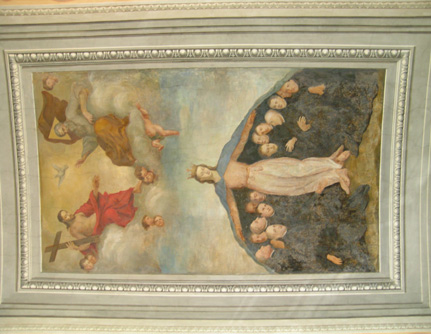
unchanged to this day. The hall is decorated with an al fresco ceiling mural portraying the
Blessed Virgin Mary enveloping in her cloak the university Jesuit professors kneeling around
her feet. When the hall was assigned to the library, and for public lectures, F.Smuglewicz
took on the work, in 1802, of redecorating it. The September 15, 1804 official inauguration
of the new university year took place in this freshly decorated hall, which made a great
impression on those in attendance. Rector H.Stroynowski was instrumental in the hall
becoming the Vilnius Imperial University Aula. In 1855 the hall was assigned to the Antiquities
Museum of the Vilnius Provisional Archaeology Commission, and when that was closed in 1865 -
to the Vilnius Public Library. The furnishings in the present Smuglewicz Hall are from the
time of the Vilnius Public Library. The classical decor of the hall was restored in 1929 by
painter and restorer J.Hopen. Painter K.Kviatkovski reconstructed the 17th century fresco.
The decor in this hall is the sole example in Lithuania of Prof. F.Smuglewicz's polychromatic
style. Today, this hall is the reading-room of the Rare Manuscript Department of the Vilnius
University Library. It offers ongoing exhibitions of books from its collection.
J. Lelewel Hall
An academy chapel was established in the second and third
storeys of a building in the west wing of the Academy Courtyard in the mid-18th century.
During the time of the Academy, the chapel arches were decorated with a plaster-rimmed mural
representing the patron saint of students, St. Stanislaw Kostka. When the Jesuit Order was
abolished in 1773, the chapel was given to the physics department, and by 1775 housed a physics
laboratory. A drawing studio for the art department was set up in the third-storey hall at the
beginning of the 19th century. It was the workplace of Prof. J.Rustem. The decor of the hall arches
was restored in 1930 by painter and restorer J.Hopen. After the restorations, this hall became the
home of J.Lelewel's collection of books and atlases, and became known as the Lelewel Hall. It now
offers a permanent J.Lelewel memorial exhibition.
White Hall
The White Hall is an integral part of the old Observatory.
It was designed and built by the celebrated Lithuanian architect and astronomer, VU professor,
T.Žebrauskas. He began the project for an astronomy observatory in the autumn of 1752. Funds
for the building were donated by I.Oginski and his daughter E.Oginskaitė-Puzynina, whose
particularly generous contribution of 200,000 Polish "auksinas" gained her the title of Observatory
patron. A surviving portrait of the benefactress shows her holding the plans for the Observatory.
The observatory building was made up of two halls - large and small - three auxiliary quarters,
and two towers. The large hall, which came to be called the White Hall, was erected on top of the
three-storey north building of the College. A small oval aperture in the middle of the arches
permitted astronomical instruments to be raised into the small hall. T.Žebrauskas' masterpiece
was embellished in 1770-1773 by Italian architect K.Spampani. He set an impressive portal with
two Doric pilasters into the west wall, and decorated the frieze metopes with four signs of the
zodiac: Aries, Cancer, Libra, Capricorn. In the centre of the tympanum is a plaster medallion
with a portrait of King Stanislas Augustus. Above the pediment is a symbolic figure of the
goddess Diana holding a portrait of benefactress E.Oginskaitė-Puzynina, and Urania with a
wreath of stars in her hand. The White Hall was used to house astronomical instruments, to
present lectures, and to carry out meridian observations. Now this hall belongs to the Vilnius
University Library, and is a reading-room for professors. The hall, decorated with old
astronomical instruments and globes, is also a venue for exhibitions.
Common reading-room
On the second floor, above the former Jesuit refectory,
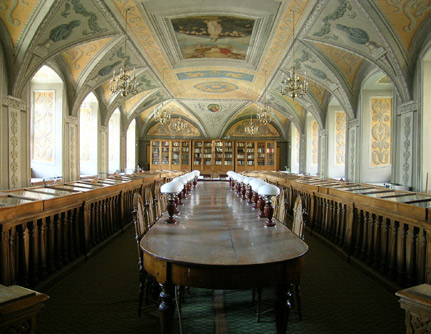
now the F.Smuglewicz Hall, is a large, 17th century hall - the former Jesuit sitting-room/library
(Hypocanastum commune). The architectural significance of the hall is emphasized by low, cylindrical,
17th century arches with lunettes. It was a splendid hall in the 17th-18th centuries: the arches were
decorated with plaster stucco mouldings, and the walls with paintings. It had eleven windows divided
into four sections, with 12, tin-framed glass panes in each section. The doors were massive, made of
oak, and above them was a gallery of four square columns, with a painting of the blessed A.Bobola
in a gilded frame. On the walls hung ornate copper engravings and maps, including a very large map
of the city of Rome, in gilded frames. Beside the windows were eleven small tables, and eleven
leather-bound seats. The writings indicate that this was the Vilnius Academy Library. The hall
held approximately 9,952 volumes of books, of which 1,063 volumes were restricted, and kept under
seal in bookcases. When the library moved to the Small Aula, the hall was turned into a minerology
museum. The hall has once again been newly restored, according to a project by architect A.Švabauskienė,
with an exposed fresco representing a blind window; there is also a memorial plaque, new floors, windows
and furniture. As of 1945, the hall has been a common reading-room for the Vilnius University Library.
Professors' reading-room
This hall was built in the 17th century, together with the
refectory and Academy library/sitting-room. It was outfitted with rooms where the Jesuit
professors lived. Each room had a glass door onto the corridor, and this floor became
known as the "glass street" during the time of the Academy. During 1819-1822, university
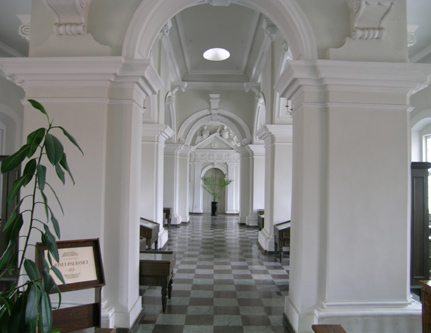
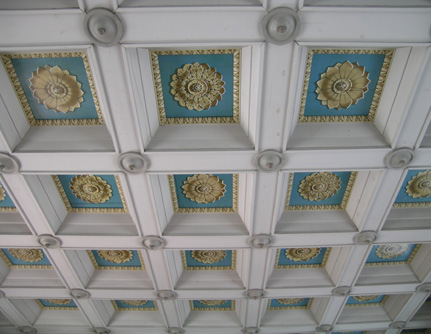
architect K.Podčašinski created an impressive, classical, deeply coffered ceiling ornamented
with rosettes and acanthus leaves. Spiral metal stairs, built along the north wall,
connected this hall with one on the second floor. When the university library moved
into the Hall of Columns, the minerology museum set itself up in both halls. The hall
was restored in 1919 by painter and professor of the Stephan Batory University,
F.Ruszczyc, who recreated the floral motif frieze which had been found under the plaster.
The hall's classical decor was restored in 1970, at which time its walls recovered
their original grey colour.
M. Mažvydas reading-room
In 1969, artist Š.Šimulynas painted a fresco entitled
"Martynas Mažvydas Ragainėje" (M. Mažvydas against a background of the city of Ragainė),
on the end wall of the Romance and Germanic philology reading-room, located on the second
floor of the north wing of the A.Mickiewicz Courtyard. In his hands, M.Mažvydas is
holding an open book, inscribed with the words of the preface to his "Catechismusa",
and so the hall took on the name of the founder of Lithuanian writing, M.Mažvydas.
The reading-room is decorated with original black metal lamps, and is innovative
in the sense that, for the first time, modern wall painting was adapted to the
architecture of the old university buildings.
The M.Poczobutt apartment
The north wing of the College Courtyard was built
during 1643-1650, on a site where wooden buildings once stood. On the south side of the
third floor of this building there was a four-room apartment, home of professor M.Poczobutt
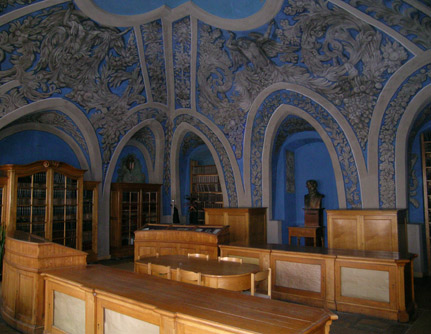
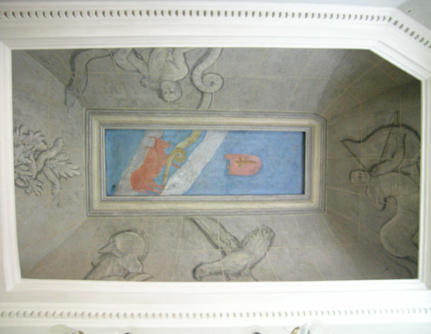
in 1764-1807, and astronomer J.Sniadecki in 1807-1825. The two middle rooms were decorated
with a classical style of painting, with each of the under-arches embracing four symmetrical
compositions. The decor is gentle and grisaille-like, with a cornice-simulating band framing
a rectangular centre within the arches, in which, painted against a blue background, are
symbols representing the constellations Taurus and Scutum. These symbols have an inscriptional
significance, and are related to M.Poczobutt's astronomical work (the scutum and taurus were
the constellatory symbols of kings J.Sobieski and S.A.Poniatowski). The painting in these
rooms was restored in 1930-1932 by J.Hopen, and renewed in 1956 by B.Motuza. After
architectural and polychromatic analyses were carried out in 1996-1997, the rooms of
the former M.Poczobutt apartment and of the Observatory annex were newly and totally
restored, according to a project by architect A.Švabauskienė. The rooms have now been
taken over by the directorate of the Vilnius University Library.
| ©
2004
|




