





|
|
|
|
|
|
>> |
- Vestibule of the Lithuanian Philology Centre
- Mosaic on the theme of Lithuanian mythology
- "Littera" bookshop
- Vestibule of the Muses
- The M. Šulcas apartment
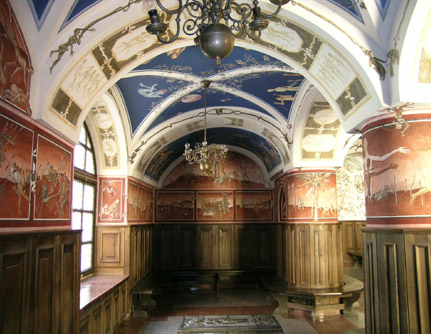
Vestibule of the Lithuanian Philology Centre
The Lithuanian Philology Centre is located on the second
floor of the east building of the Sarbievius Courtyard. Its vestibule is decorated with
artist P.Repšys' fresco, The Seasons, created in 1976-1985. It is painted in an al fresco
technique on the arches and upper walls. The wall paintings are predominantly of a rich
ochre and brown colour, the arches - dark blue. The colour and composition of the frescoes
harmonize ideally with the interior space, expose the structural elements of the architecture,
and create a uniform artistic environment. The content is taken from Lithuanian mythology, and
unveils a national concept of world harmony. The paradoxically realistic treatment of figures
dancing and playing a variety of instruments portrays the fantastic nature of the mythical
world. Out of it all, the artist creates an impressive, unforgettable vision.
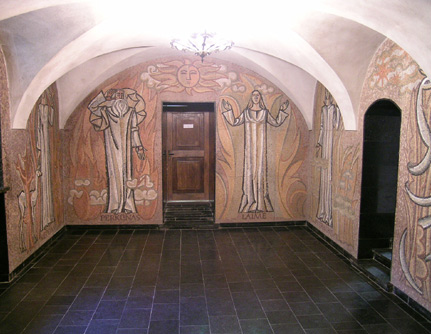
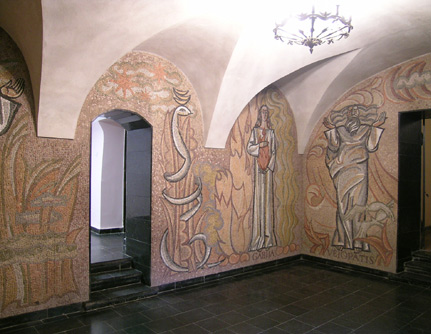
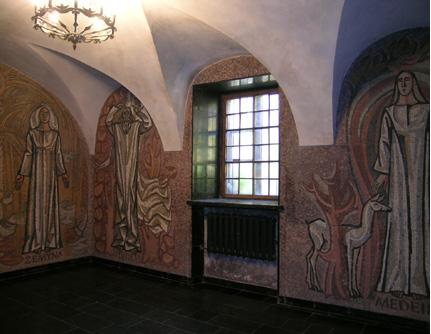
Mosaic on the theme of Lithuanian mythology
In 1978, artist V.Trušys created a granite mosaic in a
vestibule on the first floor of the east building of the A.Mickiewicz Courtyard.
The mosaic, adapted to the semicircular walls, door and window apertures, portrays
the gods, goddesses, and other mythical beings of the Balts: Perkūnas (god of thunder),
Laimė (goddess of fate),
Vėjopata (god of the wind), Gabija (goddess of fire),
Pikulas (lord of darkness), Medeinė
(goddess of the forest), Patrimpas (master of the waters),
the cold, the sun, the moon and stars. The gods and goddesses are represented with their
respective individual attributes, with their names inscribed underneath. The composition
of the figures is static and frontal the line of the contours emphasizes their silhouettes,
and gives the composition integrity and monumentalism.
"Littera" bookshop
The "Littera" bookshop is located in the centre of the university
campus, on the ground floor of the south building of the M.K.Sarbievius Courtyard. It has
kept its baroque structure and window arches. The "Littera" is known for its frescoes,
created in 1978 by A.Kmieliauskas. They are painted al fresco, in stable, colour-fast
pigments. The painted narrowing arches give the illusion of more space, and an intimate
atmosphere in the low-ceilinged environment. The reclining figures painted in the eight
segments of the arches represent the arts and sciences which flourished at the Vilnius
University. Above the pillars are oval-set portraits of the university's most celebrated
benefactors, scholars and students, their dates of birth and death, office and contributions.
The colours are a muted pastel. The little bookshop is a favourite of both
Vilnius residents and city guests.
Vestibule of the Muses
The Vestibule of the Nine Muses is on the second floor of the
south building of the S.Daukantas Courtyard. The wall painting in this area was created
in a sgraffito technique, in 1970, by artist R.Gibavičius. Represented on three walls are
the ancient Greek muses of art and science, and on the fourth - the goddess of memory,
Mnemosyne (mother of muses). The figures, with their respective attributes and inscriptions,
are laid out rhythmically in the middle of each wall. The painting is based on principles of
historicism, and unveils the possibilities of the sgraffito technique.
The M. Šulcas apartment
The north building of the M.K.Sarbievius Courtyard was reconstructed
at the end of the 18th- beginning of the 19th century. The Academy's former maintenance sheds were
rebuilt into apartments for the university's secular professors. Architect M.Šulcas carried out
his most characteristic reconstruction during 1799-1801, on the third floor of the north building
of the M.K.Sarbievius Courtyard. There he outfitted himself a small apartment of four rooms
(sitting-room, office, bedroom, dining room), with a small ante-room, storage space and kitchen
(the latter two did not appear in the architectural plans). M.Šulcas decorated the interiors of
the square-shaped rooms in a variety of classical styles, with mural decor to match each style.
The rooms were each painted in different deep colours - grey, purple, green, amber - and embellished
in both Greek and Roman orders. M.Šulcas used his apartment as a graphic example for lectures on
architectural history and planning. The apartment was restored in 1993-1996 according to a plan by
architect A.Švabauskienė. At the present time it is the office of the dean of the philology faculty.
| ©
2004
|




