





|
|
|
|
|
|
>> |
- Church of Sts. John
- The south portal
- Altar complex
- The great organ
- Presbytery stained-glass windows
- Chapel of St. Mary of Solace
- Chapel of St. Anne
- Chapel of the Body of Christ (Oginski Chapel)
- Monument to L. Kondratowicz-Sirokomle
- Monument to A. Mickiewicz
- Monument to H.Stroynowski
- Monuments to K.Sirvydas and S.Daukantas
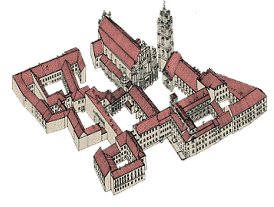
Church of Sts. John
The life of the mediaeval city concentrated around the town hall and
the city parish church, centres of juridical and spiritual life. The municipal government
intended its church to be representative, and its bell-tower to dominate in the city panorama. The
Vilnius city parochial Church of Sts. John was established at the initiative of the Vilnius townspeople
in 1386, on the eve of the Christianization of Lithuania. Its first privileges were granted by King
Jogaila: along with a churchyard, presbytery, garden and other land buildings, he gave the newly
constructed church a plot on Trakų St. (now Šv. Jono St.). The church was completed in 1426, and
consecrated by the bishops of Polotsk and Kiev on January 10, 1427. The Church of Sts. John was
tall and majestic, somewhat taller than the present one (which is a third lower than the original).
It was of a hall type with three naves, the middle nave being twice the width of the side ones. Its
mighty buttresses supported its side walls and the presbytery. The Church of Sts. John had a parish
school; in 1513 the Church was granted the right to open a primary school, which rose to the level
of college under the parsonage of the Spanish poet, P.Roizi. The Jesuit fathers arrived in Vilnius
in 1569; they were given the Church of Sts. John with its presbytery, vicarage and school buildings
by King Sigismund Augustus, with the approval of Vilnius Bishop W.Protasewicz, on April 16, 1571.
During 1580-1586 the Jesuits extended the Church of Sts. John by a third, in an eastward direction.
On August 8, 1655, the city of Vilnius was occupied by the Cossack army of Moscow czar Alexeij Michailovich.
All of the Church altars were torn down, the furnishings destroyed, and the Church itself set on fire. After
the army of the GDL liberated Vilnius in 1660, the Church of Sts. John underwent reconstruction, under the
direction of Vilnius architect J.K.Glaubitz. The Church acquired a new organ choir, and 23 new altars, highly
embellished with artificial marble (10 survived to this day); the arches were painted with frescoes, and the
building was given a new west faēade. The interior and exterior of the Church of Sts. John had reached their
apogee: there was no more decorative and majestic church in all of the GDL. At the beginning of the 19th
century, however, the artistic glory and wealth of the Church of Sts. John began to fade. The loss of
independence and the Russian hatred of the Jesuits and their art brought with them the renovations of
1826-1827. The 23 altars standing beside the pillars and side naves were demolished. The artificial
marble was hewn off, the sculptures torn down, the paintings removed, the Church fixtures thrown into
a warehouse, and the paintings in the arches covered with chalk. A second, even greater blow occurred
on July 22, 1948, when the council of the executive committee of the city of Vilnius closed the Church
of Sts. John. Then began a barbaric destruction of the Church of Sts. John, which lasted until 1963.
In 1963 the Vilnius University recovered the Church of Sts. John; with a great deal of effort and
funding, it managed to partially restore the Church and its monuments. Much of this work was initiated
by Vilnius University rector J.Kubilius. The work of rebuilding and restoring the Church
carries on unceasingly to this day.
The south portal
On November 13, 1963, the Vilnius University commissioned the
Institute of Monument Restoration to design a project for the restoration of the Church of Sts.
John. Historical material was gathered in 1964, and in 1965 engineer and architect R.Jaloveckas
carried out systematic architectural analyses of the Church. The greatest, almost sensational
discovery was a southern side portal from the first stage of its construction, at the beginning
of the 15th century. The portal led out to the churchyard, surrounded by a high brick wall,
beyond which was Šv. Jono St. The south portal, which had hindered the uniform distribtuion of
the side altars, had been carefully bricked over during reconstruction of the Church in 1749;
placed in its niche was a large copy of a statue of St. Ignatius Loyola standing on the devil
of heresy (sculptor G.Rusconi. Rome, St. Peter's Basilica). The portal had appeared once the
restorers cleaned off the plaster. This portal in the Church of Sts. John represents the early
14th-15th century stage of Lithuanian Gothic. Other examples include the Vilnius Church of St.
Michael, and the Kaunas and Vilnius Franciscan churches.
Altar complex
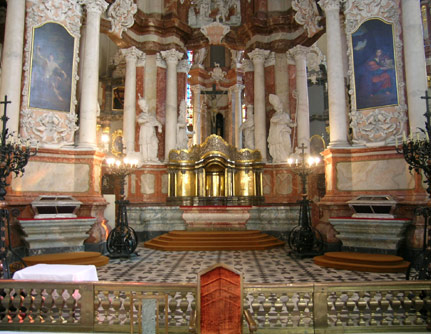
In its luxury and splendour, its expressiveness of
sculptural figures and plastic art, the Vilnius Church of Sts. John outshone the interior
of all other churches in the GDL during the second quarter of the 18th century. Architect
J.K.Glaubitz was hired to design reconstruction and renovation plans, and was assisted by
sculptor, stucco and artificial marble master J.Hedel, sculptor J.Woszczynski, artificial
marble polishing master J.Frantz, and a whole line of stonemasons and carpenters. The great,
or priestly altar, with a sculptural ensemble of the baptism of Christ above the arch, was
completed by 1745. It was connected to the adjacent altars of St. Ignatius Loyola and St.
Francis Xavier via a line of columns with pillars; above them is a curved entablature. The
lay-out of this group of altars was innovative, for they were created as an independent
architectural partition of the central nave, and thus had no engineering function. The
altars are decorated with seven large statues of the Sts. John, created by sculptor J.Woszczynski.
Between the columns one can see the altars in the choir space behind the great altar. Standing
on a high dais behind the great altar, right next to the east wall, is the altar of Maria of
Loretto. There are six other altars across from the presbytery, in the north and south naves.
In the north nave, from left to right are the altars of St. Joseph, St. Casimir, and the
Crucified Christ. On the south side - Sts. Peter and Paul, St. Michael, and the Sorrowing
Mother of God. Thirteen altars, masterpieces of baroque art, were lost forever, destroyed
in 1827, when the heads of the Vilnius Imperial University undertook Church renovations.
In 1974-1979, restorers uncovered a painting portraying the beheading of St. John the
Baptist, above the arches of the great altar in the central nave.
The great organ
In 1739 a new, majestic, wonderfully decorated organ choir arose out
of the solid stone. A unique embellishment are J.K.Glaubitz's beloved closed frame panoplies,
which decorate the entire parapet. When the Polotsk Jesuit Academy was closed, remaining in the
Academy church was a huge, ornate, powerful organ, which was presented to Vilnius on February 21,
1836. A special committee, headed by Warsaw composer J.K.Elsner, approved the newly mounted 40
key organ with 2,438 pipes, on October 9, 1839, and declared its installation perfect, its sound
ideal. The celebrated musician and composer, Church of Sts. John organist S.Moniuszko, was
performing on the newly installed organ by September 1, 1840. Fortunate circumstances saw
to it that J.K.Glaubitz's organ choir survived to our day. The organ itself was not so lucky -
only the boards of the organ prospect were left. Thanks to the great efforts of organ masters,
and the determination of the university heads to restore the instrument, the Church of Sts. John
organ, with 65 keys and 3,600 pipes, was heard once again on March 11, 2000.
It is the largest organ in Lithuania.
Presbytery stained-glass windows
In 1887, father K. Pacinka, who showed great initiative
in maintaining and decorating the church - and did so with his own funds - was appointed
pastor of the Church of Sts. John. In 1898, seven presbytery stained-glass windows were
manufactured at the E.Todes stained-glass worskshop in Riga, and installed in the altar
end of the Church in that same year. When the Church of Sts. John was closed on July 18,
1948, the stained-glass windows were almost totally destroyed. With the onset of restoration
work, student A.Grabauskas of the stained-glass department at the Vilnius Art Institute
carefully gathered and wrote a description of the remains of the broken windows. When the
Vilnius Restoration Trust set up a laboratory, A.Grabauskas used the experience of his
earlier studies, and the stained-glass remains to completely rebuild the huge windows
of the presbytery. The mysterious light of the great stained-glass windows has once
again merged with the presbytery altar ensemble to create a magnificent impression.
Chapel of St. Mary of Solace
It is also called the Chapel of St. Stanislaw Kostka, and the
middle chapel of the student congregation. The chapel was built in the north churchyard, in
the former garden, during the first half of the 17th century. Its exterior architecture is very
reserved, laconic, characteristic of all Vilnius baroque constructions at that time. Above the
altar end is a cupola with lantern. During the 17th-18th centuries, this chapel had a direct passage-way
to the central building of the Vilnius Academy. When the chapel was restored in 1969, fragments of
portrait painting were uncovered in the cupola arches, and almost all of its wall murals were
restored by 1981. The painting covers the upper walls, the arches of the west lintels, and in the east
part - the tambour, cupola and lantern. On June 19, 1726, the Holy Vatican Congregation, chaired by
Pope Benedict XIII, canonized two Jesuit students: Stanislaw Kostka and Aloitius Gonzaga. The Chapel
of St. Mary of Solace at the Vilnius Academy Church of Sts. John was dedicated to St. Stanislaw Kostka.
On that occasion, the chapel was newly painted with scenes of the miracles which the saint had performed,
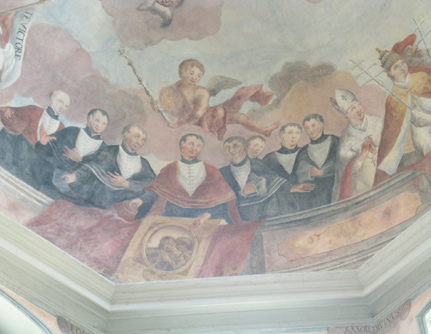
his canonization, and glorification in heaven. A group of four personalities, with Pope Benedict XIII
in the middle, wearing pontifical robes and tiara, is represented on the north arch of the cupola. On
his right, on the north-west part of the cupola arch, are eight Jesuit figures. In their centre is a
man with a wide red toga - Vilnius University rector V.Daukša. In his right hand he is holding a red
rector's beret, and with his left hand he is pointing to the canonized young men's portraits. Above
his head a flying genius of honour holds the sceptre of the Vilnius Academy rector. Represented in the
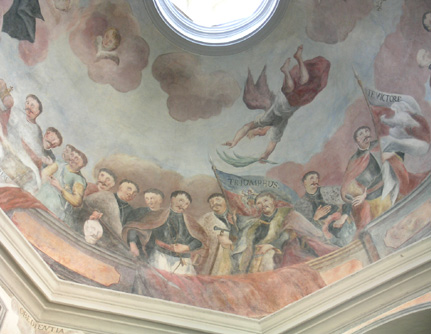
south-west corner of the cupola are two Polish aristocrats with the Polish flag. Lined up on the south
side of the cupola is a delegation of eleven Lithuanian aristocrats with the two-colour flag of the GDL.
The GDL officials are personalized, and appear to have been copied from engraved portraits. Represented
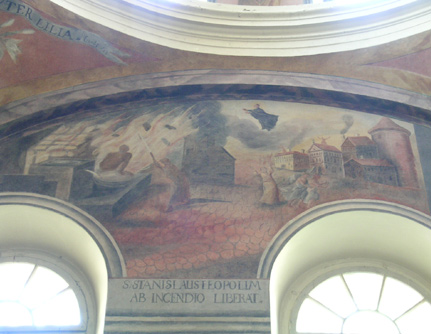
on the south wall, above the door, is the baptism of the infant Stanislaw Kostka, and on the north wall,
above the windows - the miraculous rescue, with the aid of St. Stanislaw Kostka, of the city of Lvov from
a fire. This chapel is now outfitted as a funerary hall.
Chapel of St. Anne
It is also called the Chapel of St. Michael, the Chapel of the
Immaculate Conception of the Blessed Virgin Mary, the Chapel of the Guardian Angel, and the small
chapel of the student congregation. The real date of the construction of the chapel is unknown.
Location research indicates that it was built at the turn of the 18th century. The most
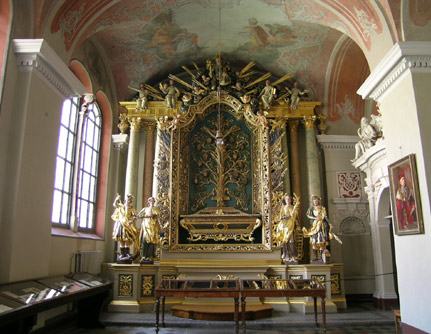
significant artistic merit of the Chapel of St. Anne is its wooden, heavily carved mid-18th
century altar of St. Victorino. The crucifixion on the olive tree is related to the mystery
of the eucharist - the transformation of wine into the blood of Christ. The olive tree itself
is seen growing out of St. Victorino's casket. St. Victorino lived in the 3rd century, under
the rule of Roman emperor Maximian, and served in an officers' garrison in the city of Marseilles,
where he was martyred for preaching Christianity among the soldiers. Reminding us of the sacrifice
of St. Victorino are four of his contemporaries, martyrs as well, whose statues stand like guards
beside the casket of the saint. Two of them are also soldiers from the Roman army: St. George and
St. Florian, martyred for preaching Christianity by emperor Diocletian in ca. 304. The other two
are priests: St. Stephen and St. Laurynas, both of whom were killed for their beliefs. The first
was stoned to death in Jerusalem, the second burned at the stake in Spain in 258. The architectural,
sculptural, and painting elements of the interior of the Chapel of St. Anne are very harmonious,
uniform, and form a congruous whole.
Chapel of the Body of Christ (Oginski Chapel)
The Chapel of the Body of Christ was built in approximately
1573, and was cared for by the Brotherhood of the Adoration of the Body of Christ. Artistically,
the most important and interesting facet of the Chapel of the Body of Christ is the painting of
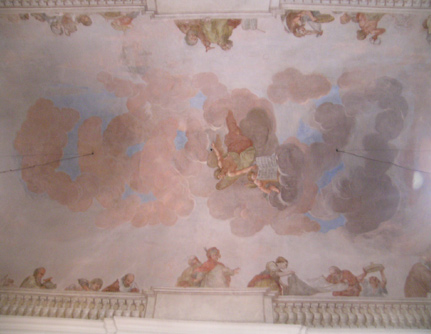
the arches. The frescoes therein portray the significance of the mystery of the eucharist. The
composition is made up of three thematic motifs. The first, introductory theme, is the story
of the Old Testament where Christ feeds heavenly manna to the Israelites in the wilderness. The
second motif, in the centre of the arches, is that of a large winged angel among the clouds,
with an open book inscribed with the Latin text from the Gospel of St. John: "…not Moses / who
gave you bread from heaven, / but my Father, / who gives you real bread from heaven". The third
motif is in the east, in the altar end of the arches, and portrays the Ark of the Covenant,
surrounded by angels; above that, in the clouds, is a gold chalice and the host, the symbol
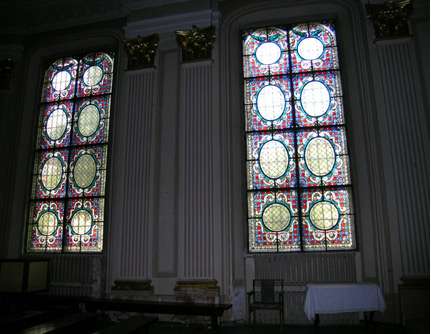
of the mystery of the Mass, and of the divine incarnation. I.K.Oginski had the idea to install
stained-glass windows in the Chapel of the Body of Christ. The sketches according to which the
firm of Lorano and Gazel in Paris manufactured the stained-glass, were created by painter J.V.Puzinas.
The stained-glass windows were destroyed in 1944. Artist and restorer A.Grabauskas recreated the
entire ornamental system out of fragments of glass, in 1980. Only the medallions were missing the
images of the saints. At the present time, the Chapel of the Body of Christ holds the Holy Sacrament.
Monument to L. Kondratowicz-Sirokomle
This monument was created by P.Velionskis, a sculptor of
Lithuanian origins. The poet's bust and lyre were completed and cast in bronze at the
sculptor's workshop in Warsaw, in 1904. The monument was officially unveiled and consecrated
on September 29, 1908, in the Church of Sts. John. The people of Vilnius were especially fond
of its popular nature, as evidenced by the inscription: "Our village bard died here while playing the lyre".
Monument to A. Mickiewicz
The year 1898 - the 100th anniversary of the birth of poet
A.Mickiewicz - was drawing near. The idea to erect a monument to the poet in Vilnius was
first raised by L.Uzembla. A monument-building committee was set up in 1897. Because
political restrictions did not permit the construction of a monument in a public square,
the idea stopped at the Church of Sts. John of the former university, from which A.Mickiewicz
had graduated. Committee chairman, artist B.Rusecki, purchased one of three examples, a bronze
bust of A.Mickiewicz, made by sculptor M.Guiski in Paris, from count Puslovski in Cracow.
The project for the monument was designed by architect T.Strijenski, and the mounting carried
out by sculptor J.Rudnicki. The monument was quietly unveiled on June 6 (18), 1899.
Monument to H.Stroynowski
In 1827, the university council decided to build a monument in the
Church of Sts. John in memory of former university rector H.Stroynowski. Funds for the monument
were donated by Vilnius University professors and staff members. It was designed by university
architect K.Podczaszinski. The figurative and decorative mouldings, as well as the Stroynowski
bust, were created by sculptor K.Jelski. The monument was officially unveiled on Nobember 10, 1828.
Monuments to K.Sirvydas and S.Daukantas
Following the tradition of erecting monuments in the Church of Sts.
John, in 1979, on the 400th anniversary of the Vilnius University, monuments were built therein in
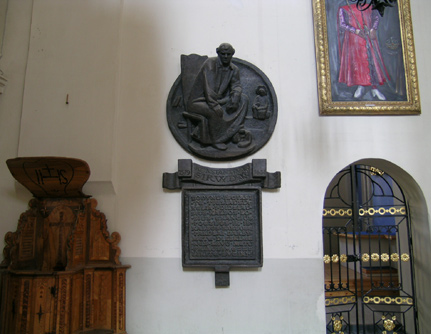
memory of Vilnius University professor, theologian, and Church of Sts. John preacher K.Sirvydas
(sculptor J.Kėdainis), and of the author of the first history of Lithuania in the Lithuanian language,
S.Daukantas (sculptor G.Jokūbonis).
| ©
2004
|




