


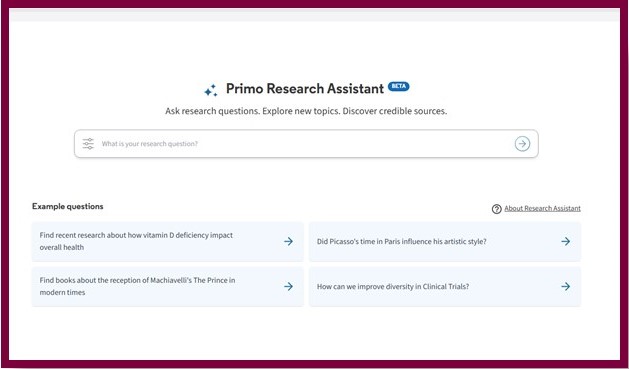
We invite you to try the generative artificial intelligence (AI) tool 'Research Assistant' based on the Big Language Model (GPT-4o mini) in Vilnius University Virtual Library.
Why try the 'Research Assistant'?
- Searchable in natural language;
- Access to reliable e-resources from scientific information databases;
- Quick discovery of new research topics and suggestions for related questions to deepen your understanding of the topic.
How does the 'Research Assistant' work?
When searching for research information, a query consisting of keywords is generated as usual. Experienced researchers know that keywords are combined using Boolean operators like 'and,' 'or,' and 'not.' With the Research Assistant, the AI handles this step automatically, eliminating the need for manual input.
When a question is asked in natural language, it is automatically converted (without the user seeing it) into a query made up of the question's keywords and their synonyms connected by Boolean logical operators. This query is then used to search for academic text summaries that most closely match the keywords. Once these are found, the user is presented with five sources of scientific information. From these summaries, a concise answer to the research question is generated along with links to the sources.
When a research question is asked in Lithuanian, it is automatically translated into English ensuring that both Lithuanian and English e-resources are included in the search results.
Thus, having found out how the 'Research Assistant' works, we can conclude that AI does not replace the traditional method of scientific information search, but rather simplifies it by performing specific search steps on behalf of the user.
The text was translated from Lithuanian to English using artificial intelligence (AI) tools.
Eglė Eidėnaitė
2025-04-10