

 Do you know what is common between the famous French surgeon Dominique-Jean Larrey (1766–1842), Robert Koch (1843–1910), the discoverer of the tuberculosis and cholera bacilli, and Edward Jenner (1749–1823), the pioneer of smallpox vaccination?
Do you know where the famous professors Jędrzej Śniadecki, Augustus Bécu, and Wacław Pelikan, rector of Vilnius University, had their apartments?
Do you know which Vilnius physician was sentenced by the Tsar’s military tribunal to 15 years of hard labour for participating in the 1830–1831 Uprising and, in a public execution, stripped of his noble title by breaking his sword (a symbol of nobility) over his shaved head?
Have you ever seen the first inhalation devices or an ambulance?
Have you heard of a terrible recurrent disease of the whole body called Polish plait (Latin: plica polonica)?
What are the strangest objects swallowed by people, and what does a spoon look like when it is pulled out of a person’s digestive tract?
Have you heard about the therapeutic qualities of amber oil, and do you know how to use it?
Which surgeon and anatomist’s head is still on display at the Pavia University’s History Museum?
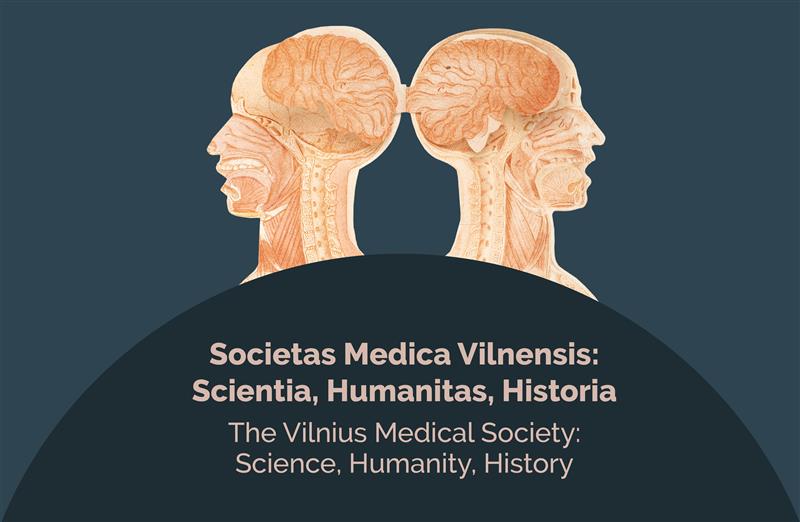
A visit to the new exhibition at Vilnius University Library—“Societas Medica Vilnensis: Scientia, Humanitas, Historia / The Vilnius Medical Society: Science, Humanity, History”, dedicated to the 220th anniversary of the Vilnius Medical Society, which is being celebrated this year—will give the answers to these and many other questions. Founded on 12 December 1805, the Society was the first of this kind in Eastern Europe. Moreover, it continues its activities to the present day.
Those attending the exhibition will have the opportunity to see historical documents from the Vilnius Medical Society dating from 1805 to the first half of the 20th century, which are kept in Vilnius University Library.
The first part of the exhibition is dedicated to the establishment of the Vilnius Medical Society; therefore, visitors will see founding documents, lists of members, blueprints of the Society’s premises and property as well as documents related to various areas of the Society’s activities. The Society’s “Golden Book”, a register of 1,286 members from the Society’s founding until 1928, which is included in the Lithuanian National Register of the UNESCO “Memory of the World” Programme, is worth special attention.
The second part of the exhibition shows the Society’s connections with scientists from other countries and the scientific input of the Society’s members. Here you will see letters, notebooks and other research papers written by the discoverer of the smallpox vaccine Edward Jenner, anatomist and surgeon Antonio Scarpa, discoverer of the tuberculosis and cholera bacilli Robert Koch, surgeon Nikolai Pirogov, chemist Dmitri Mendeleev, winner of the Nobel Prize in Physiology and Medicine Emil Adolf von Behring, the eminent paediatrician Max Kassowitz, the pioneer of urology Jean Guyon, and other famous scientists. You will also find the works and achievements of actual members of the Vilnius Medical Society that had a great impact on the life of our country and the city. The exhibition is illustrated with the Society members’ portrait photographs from two albums of photographs compiled on the initiative of Władysław Zahorski, “Album Cesareae Societatis Medicae Vilnensis”, and other publications related to medicine from the 16th to 19th centuries.
The exhibition will be on display at Franciszek Smuglewicz Hall of Vilnius University Library (Universiteto str. 3) from 5 December 2025 to 17 April 2026. Opening: on 5 December 11 a.m.
We cordially invite you to visit the exhibition!
Valentina Karpova-Čelkienė
2025-11-27