

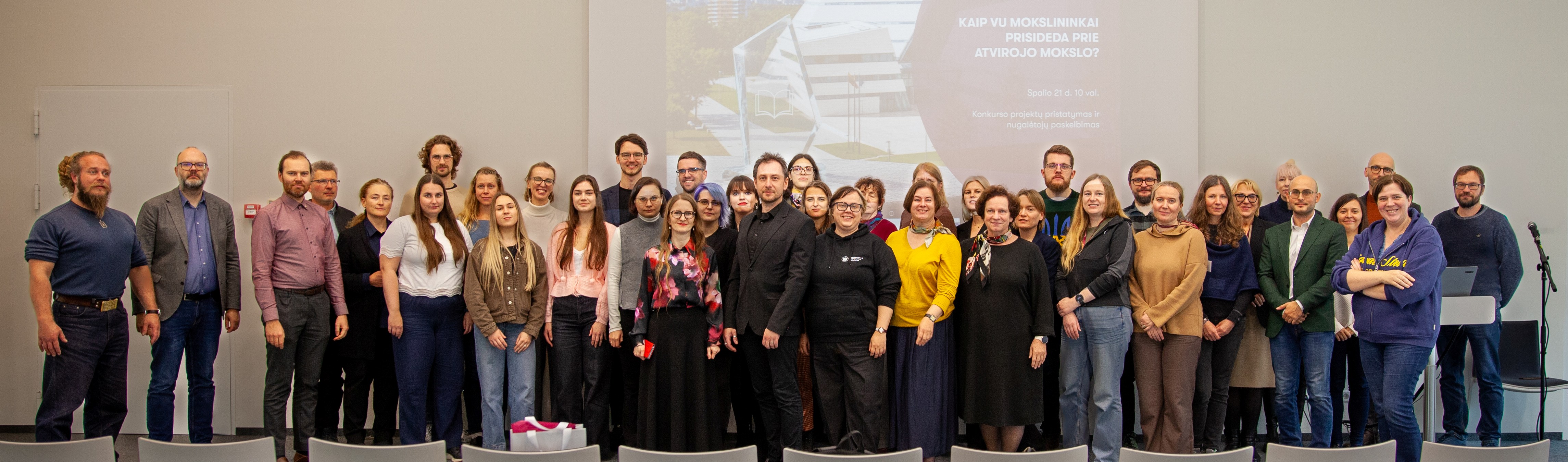
On 21 October, for the third time, Vilnius University Library hosted an event to present participants in Vilnius University’s competition for contributions to Open Science and announce the winners. This year, the competition received 30 applications, showcasing a variety of Open Science activities, projects, and initiatives undertaken by Vilnius University community.
The competition’s jury selected one winner in each of the three categories.
In the category “Openness and International Aspect in Research”, the ERC Consolidator Grant project “MILWAYS” team, from the Department of Archaeology of the Faculty of History (Vilnius University), was awarded the prize.
The project is led by Prof. Dr Giedrė Motuzaitė Matuzevičiūtė Keen. The team consists of postdoctoral researchers Dr Margaux L. C. Depaermentier and Dr Marine Morvan, doctoral students Meiirzhan Abdrakhmanov, Kyriaki Karanikola and Rūta Karaliūtė, research assistant Rėda Nemickienė, and project partners from other countries and fields of science.
The “MILWAYS” project investigates the role of millet in Europe’s past and future food systems, and one of the team’s key operating principles is the open sharing of research data, methods, programme code and results. During the period under review, the team published open access articles, made datasets and software tools publicly available, and presented the research findings to the international scholarly community and the general public.
In the category “Engagement of the Public in Science”, the winner was Assoc. Prof. Dr Giedrė Godienė from the Department of Geography and Land Management of the Institute of Geosciences, the Faculty of Chemistry and Geosciences (Vilnius University).
She was awarded for her “Geography Night” initiative, which introduces the science of geography to the public through free, open and engaging events and citizen science activities. Since 2019, 189 “Geography Night” events have been organised in Lithuania, attended by more than 11,000 people. In 2026, during the competition’s assessment period, 46 “Geography Night” events were held in 24 locations across Lithuania, attended by 3,141 people. More than 40 organisers contributed to the event. The initiative brings together scholars, schools, science centres, museums, protected area authorities and local communities, and some of the activities involve public participation in the collection, analysis and interpretation of geographical data.
The winner in the “Impact of Open Science” category was the Centre of Excellence of Vilnius University “Data Centre for Machine Learning and Quantum Computing in the Natural and Biomedical Sciences”.
The Centre brings together researchers from the Faculty of Mathematics and Informatics, Life Sciences Center, Faculty of Medicine, and Faculty of Chemistry and Geosciences of Vilnius University. It is represented by Prof. Dr Jurgita Markevičiūtė, Prof. Dr Povilas Treigys, Prof. Dr Remigijus Paulavičius, Prof. Dr Saulius Gražulis, Prof. Dr Arvydas Laurinavičius and Prof. Dr Linas Vilčiauskas. The jury awarded the Centre for its significant contribution to the creation and development of an open scientific data infrastructure and for facilitating the reuse of data in natural and biomedical sciences research.
The infrastructure being developed by the Centre is designed for the storage and processing of large volumes of scientific data, as well as for machine learning and quantum computing tasks. From an Open Science perspective, it enables research data to be managed in accordance with the FAIR principles, ensuring its long-term preservation, reuse and accessibility to the international scientific community. The Centre’s activities also include initiatives to disseminate open research data and scientific knowledge beyond the university.
This year’s competition winners reflect different aspects of Open Science, ranging from open data and international collaboration to public engagement and the development of open research infrastructures.
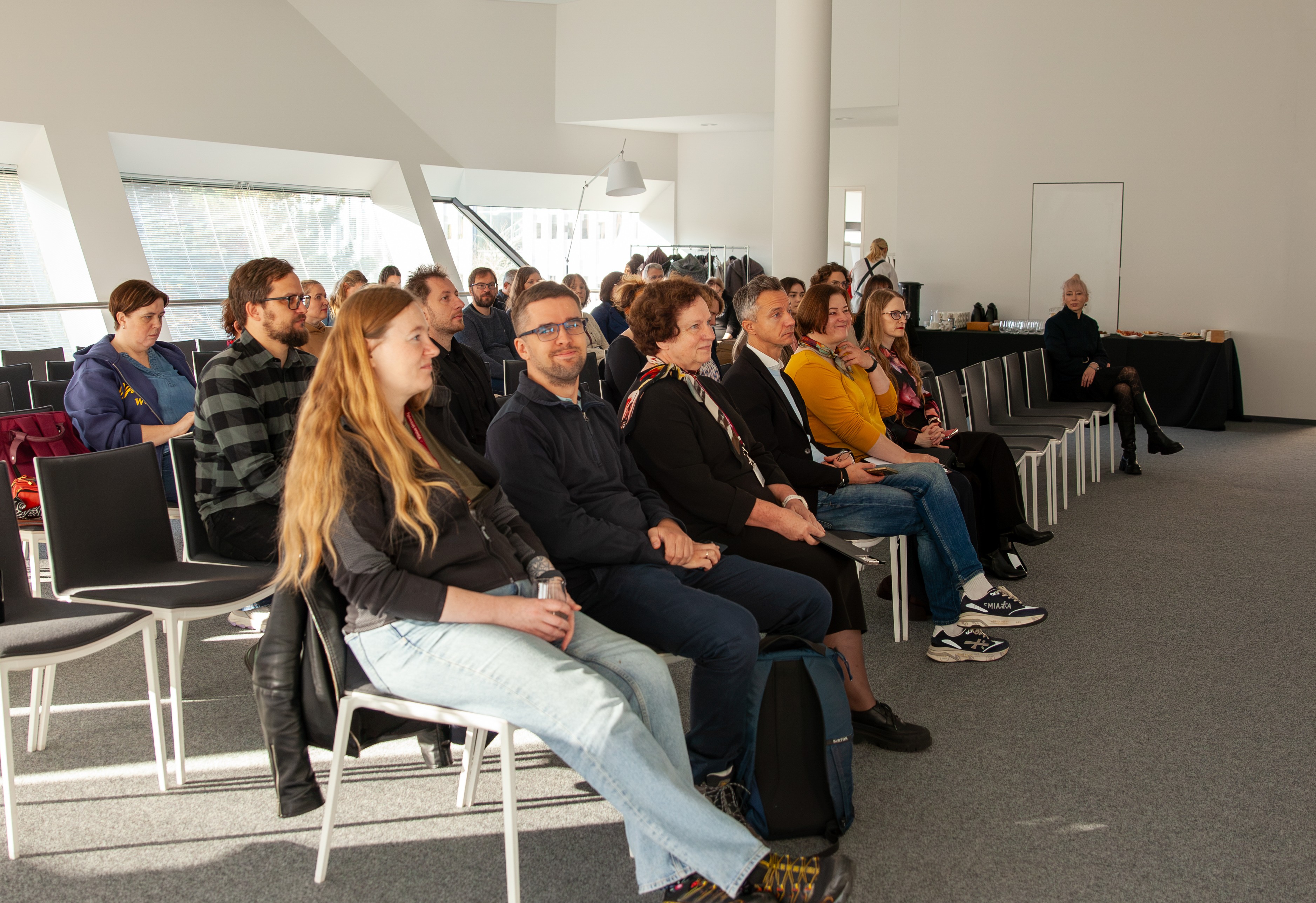
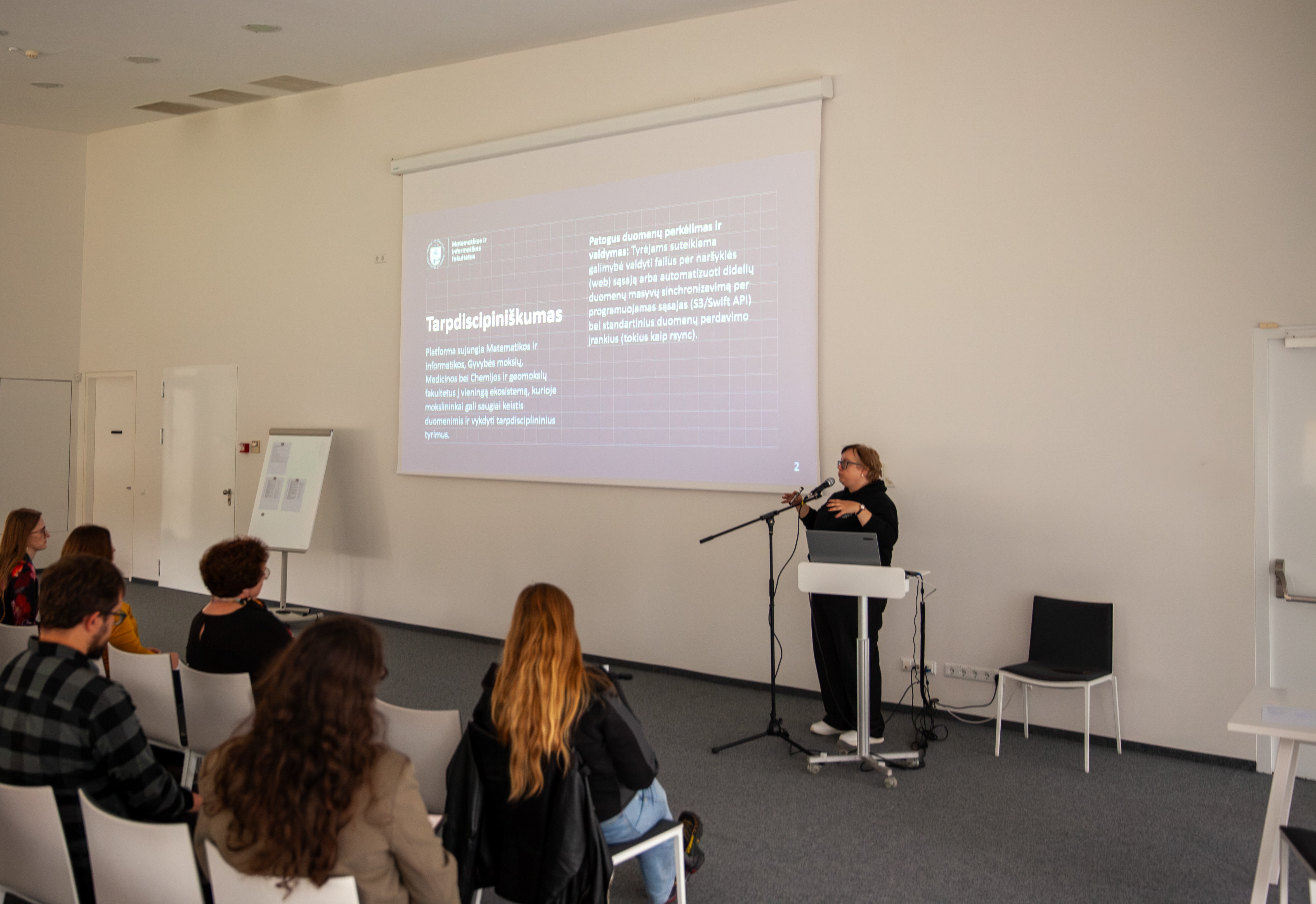
Moments from the event. Photo by A. Petrošius.
The jury also gave honourable mention to three highly rated applications: Dr Vytautas Samalavičius for his open and reproducible research in hydrogeology and artificial intelligence; the team of the Lithuanian Population and Rare Diseases Biobank for engaging the public in biomedical research and developing an open biomedical data infrastructure; and Dr Gintautas Bagdžiūnas for actively involving the public in scientific activities, popularising science in the fields of bioelectronics and astrobiology, and openly sharing research results.
The jury would also like to thank all competition participants for their applications, the time they have devoted, and their contribution to the development of Open Science at Vilnius University. This year’s competition attracted high-standard and diverse applications, reflecting a broad spectrum of Open Science practices, ranging from the opening up of scientific data and methods to public engagement, scholarly communication, international collaboration and the creation of open scientific infrastructures.
The competition is one of the activities set out in the implementation plan for Vilnius University’s Open Science Policy Guidelines and traditionally takes place during International Open Access Week. It aims to recognise and encourage the activities of members of VU’s community that contribute to a more open, collaborative and publicly accessible science. The competition is organised by Vilnius University Library, the Department of Science and Innovation (Vilnius University), and the Communications and Marketing Division (Vilnius University).
Rusana Minkevičiūtė
2026-10-23